
Crude Oil Prices: Market Drivers, Economic Impact, and Future Forecasts
The global energy market is undergoing a massive transformation, yet one commodity remains the undisputed king of macroeconomic trends: crude oil. For investors, businesses, and financial analysts, tracking crude oil prices is not just about monitoring fuel costs—it is about reading the pulse of the global economy.
Understanding the intricacies of the oil market is essential for strategic asset allocation and risk management. This comprehensive guide breaks down the core drivers of crude oil pricing, its macroeconomic ripple effects, and what the future holds for this critical commodity.
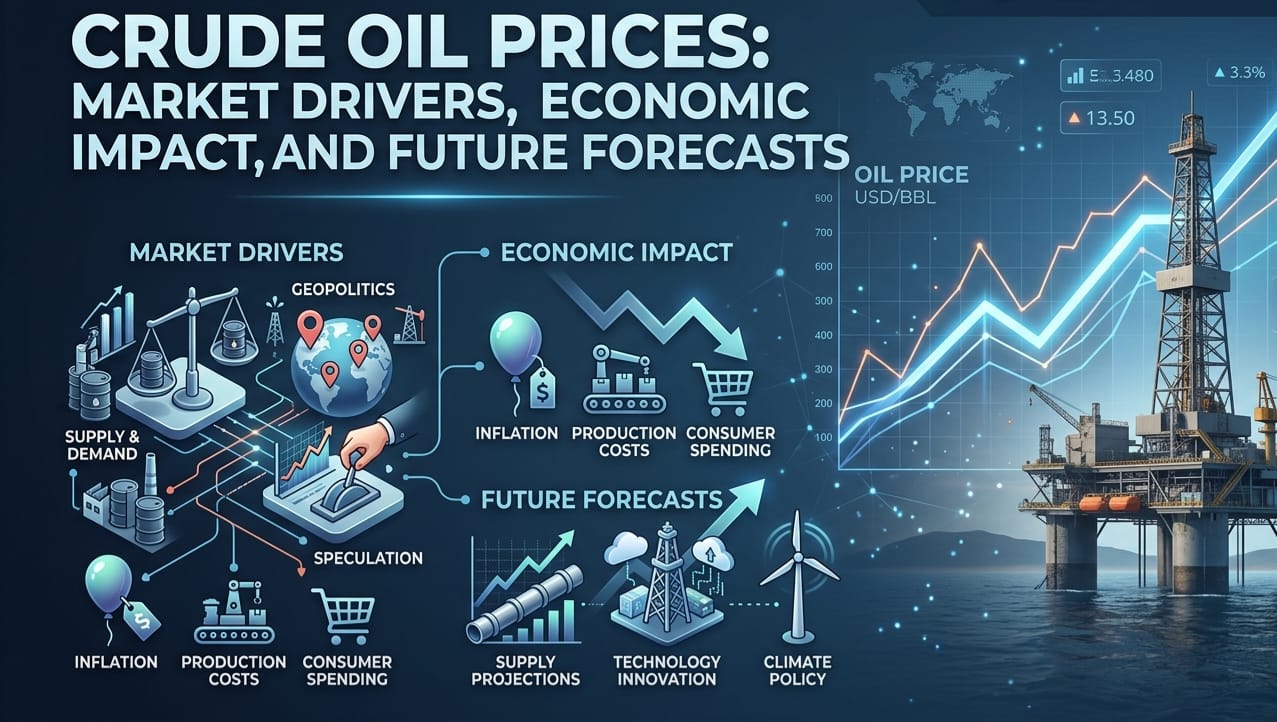
1. The Core Drivers of Crude Oil Prices
Crude oil does not trade in a vacuum. Its price is determined by a complex interplay of geopolitics, economics, and market sentiment.
A. Supply and Demand Dynamics
At its fundamental level, oil pricing follows basic economic laws. However, the supply side is heavily influenced by major cartels and nations:
-
OPEC+ Alliances: The Organization of the Petroleum Exporting Countries (OPEC) and its allies (including Russia) actively manage production quotas to stabilize or boost prices.
-
US Shale Production: The United States has emerged as a swing producer. High shale output can counter OPEC’s production cuts, keeping global prices in check.
B. Geopolitical Risks
Oil reserves are heavily concentrated in politically volatile regions, particularly the Middle East. Geopolitical tensions, trade wars, shipping disruptions (such as issues in the Suez Canal or the Strait of Hormuz), and international sanctions instantly inject a risk premium into crude oil prices.
C. Currency Fluctuations (The US Dollar Effect)
Crude oil is globally benchmarked and traded in US Dollars (USD). Consequently, there is an inverse relationship between the strength of the dollar and oil prices:
-
When the USD strengthens, oil becomes more expensive for foreign buyers, dampening demand and lowering prices.
-
When the USD weakens, oil becomes cheaper for non-dollar economies, driving up demand and prices.
2. Brent Crude vs. WTI: Understanding the Benchmarks
When financial news networks report on crude oil prices, they generally refer to two primary benchmarks:
| Feature | West Texas Intermediate (WTI) | Brent Crude |
| Origin | Extracted from US wells (primarily Texas). | Sourced from North Sea oilfields in Europe. |
| Delivery Point | Landlocked (Cushing, Oklahoma). | Waterborne (easy international shipping). |
| Quality | Very sweet and light (ideal for gasoline). | Light and sweet (ideal for diesel and gasoline). |
| Global Usage | Benchmark for US domestic oil. | Benchmark for roughly two-thirds of global oil trades. |
3. How Oil Prices Impact the Global Economy
Fluctuations in the energy sector create a domino effect across various asset classes and economic indicators.
Inflation and Central Bank Policies
Energy is a primary input cost for manufacturing, agriculture, and transportation. A sustained spike in crude oil prices pushes up the Consumer Price Index (CPI). To combat this supply-side inflation, central banks (like the Federal Reserve) often raise interest rates, which can slow down economic growth and impact stock market valuations.
Corporate Earnings and Equity Markets
The impact of oil prices on equities depends entirely on the sector:
-
Winners: Oil exploration, production, and refining companies (e.g., ExxonMobil, Chevron, Shell) see immediate revenue growth.
-
Losers: Transportation, aviation, paints, and automobile industries face severe margin compression due to rising input costs.
4. The Future Forecast: Decarbonization vs. Oil Dependency
As the world pivots toward ESG (Environmental, Social, and Governance) standards and renewable energy, the long-term outlook for crude oil prices is facing structural shifts.
The Energy Transition Paradox: While investments in electric vehicles (EVs) and renewable grids are accelerating, global oil demand has not yet peaked. Underinvestment in traditional oil exploration during the transition phase could actually cause supply shortages, leading to highly volatile price spikes over the next decade.
Investors should closely monitor Peak Oil Demand forecasts alongside traditional metrics like OPEC meeting outcomes and US inventory reports to navigate this market successfully.
Conclusion: Strategic Takeaways for Investors
Crude oil prices remain a critical barometer for global financial health. Whether you are a day trader looking at short-term technical indicators or a long-term value investor analyzing macroeconomic trends, keeping a close eye on the energy sector is non-negotiable.
To hedge against oil price volatility, diversifying into energy equities, commodities ETFs, or clean energy alternatives is a proven strategy to protect your portfolio in an uncertain economic landscape.
Ajit Jadhao

Thanks for visiting Ajitation.com, Ajitation is optimized for learning and training. Examples might be simplified to improve reading and learning. Tutorials, references, and examples are constantly reviewed to avoid errors, but we cannot warrant full correctness of all content.